Reflection Overview
This week focused upon a continuation of last week’s discussion of algorithms within both surreal and realistic contexts; Leigh Alexander’s The Soft Truth and Kevin Roose’s The Making of a YouTube Radical respectively.
The Soft Truth
A constant shadow, the narrator is entranced at all moments by the gelatin sphere, a non-physical entity taking place within the YouTube algorithm. Her physical self is cursed with endless scrolling through algorithmic driven thumbnails, one of which many of us can relate to, despite whether we are the targeted demographic or not. I personally identify her “other” as the part of her not overwhelmed by the sphere, gazing upon her mistake. The ending sparks much conversation, but one might suggest that the narrator loses that “other” part of herself, becoming completely overtaken by the sphere. The overarching meaning of this piece demonstrates how integral algorithms are to our every day lives, fueling mindless behavior that increases our reliance on technology.

“Making of a YouTube Radical”
The “YouTube rabbit-hole” is often a phrase used by many when an individual becomes intertwined inside of a more niche and specific area of the video-hosting site, housing typically verbose and niche content. In respect to this article specifically, I was surprised by the site’s algorithm that promoted such radicalized content, shifting the individual in question’s political ideology. I was familiar to the term “red-pill” prior, but not within the context of far-right conversion. The piece offers a perspective that is interesting when considering the harsh realities algorithms might lead one into, relating to the concept of “data-voids” in which oddly specific search terms yield unintended results, often associated with advertisements or underlying tactics.
GoBing Detroit
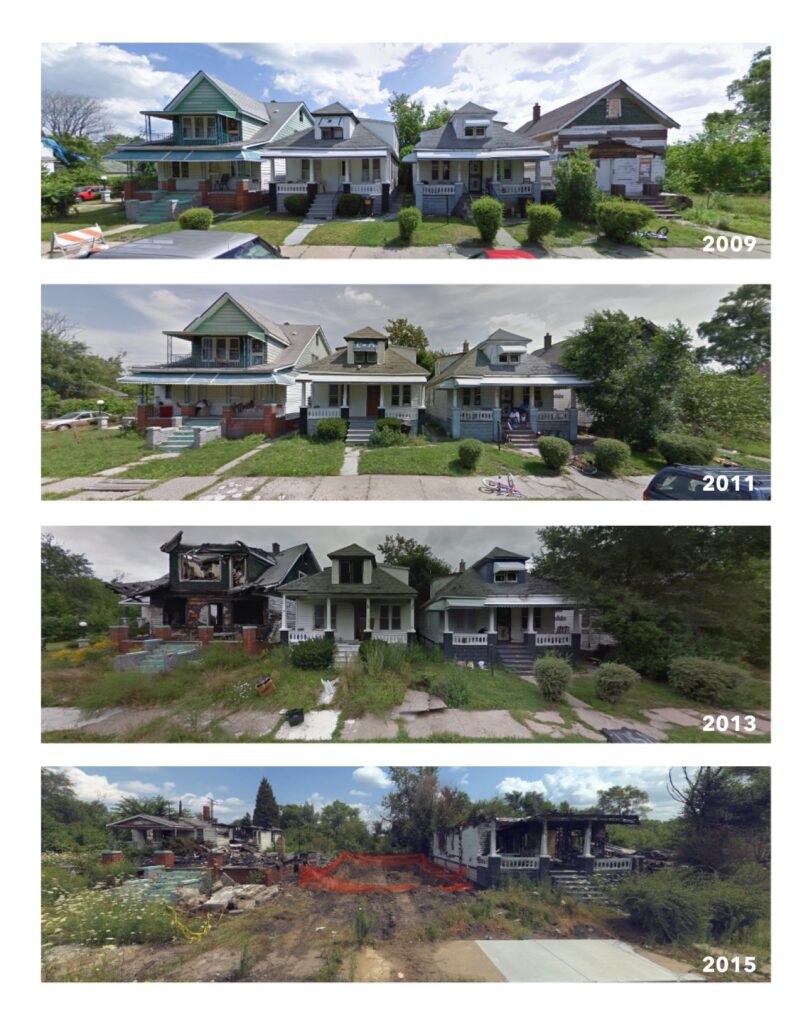
Using Google Street View, it was interesting to see the natural progression of homes through abandonment, foreclosure, and unfortunate cases of disaster. This project demonstrates this efficiently, and I found it interesting to survey streets to seek out changes in the landscape. Personally, I found results to be more sparse than shown in pictures, but there were definitely noticeable differences.